A sound work can feel different near a doorway, beside a wall and in the center of the room even when its playback has not changed. The listener has moved through a changing combination of direct and reflected sound. Position is part of the acoustic situation.
This does not mean every change is mysterious or every unevenness is a technical fault. Understanding a few physical relationships makes it easier to describe the experience and to ask useful questions about a space.
The direct path is only one route
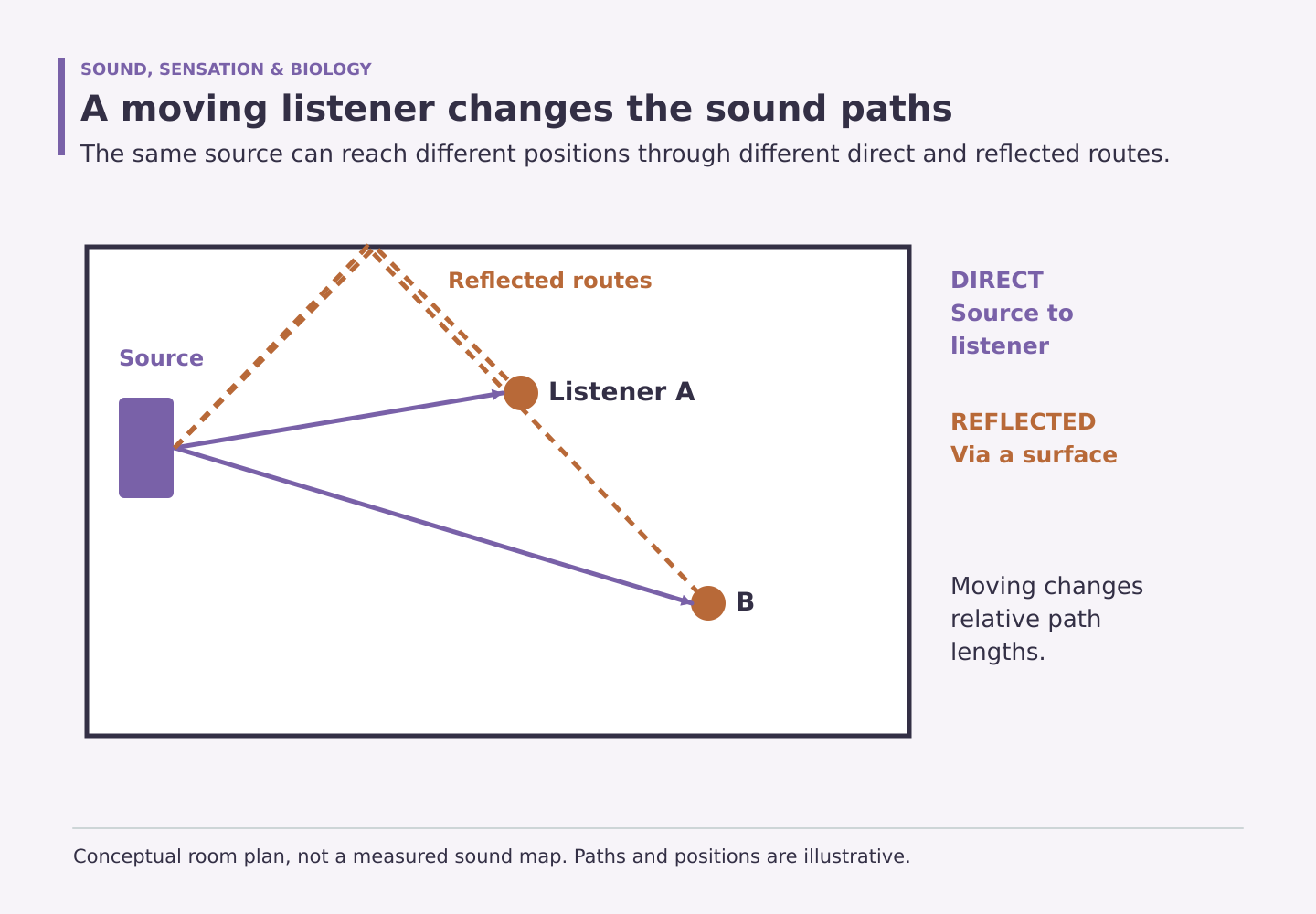
Sound from a loudspeaker can reach a listener directly, but it can also encounter the room’s surfaces before arriving. Those additional paths have different lengths and interactions with surfaces. The listener receives their combination rather than an isolated copy of the source.
A floor-plan sketch is a useful starting point. Mark the source, listener and several major surfaces. Draw one direct path and one possible reflected path. The sketch does not need to model every reflection to explain why moving the listener changes the geometry.
Keep the drawing honest: straight arrows represent simplified travel paths, not a complete simulation of a real room. Furniture, openings, people and the frequency content of the sound all complicate the situation.
Overlapping waves can reinforce or reduce a component
The OpenStax explanation of wave superposition describes how overlapping waves combine. Depending on their relative phase, contributions can reinforce one another or partly cancel at a particular location.
For a single repeating component, changing a path length changes the relationship between arrivals. With complex audio, many frequency components are present at once, so the result is not simply “all louder” or “all quieter.” Some aspects of the sound can become more prominent while others become less prominent.
This helps explain a common observation: stepping sideways can change the apparent balance of a sustained sound without anyone touching the volume control. The geometry has changed even though the source setting has not.
Room shape changes where reflections go
Some spaces make reflection paths especially noticeable. The Exploratorium’s Rotunda Echo exhibit uses a domed setting to demonstrate how reflected sound can produce a distinctive listening experience.
A museum example is useful because it makes room geometry part of the phenomenon rather than treating the room as an empty container. A flat wall, curved surface and open doorway need not contribute the same acoustic pattern.
Still, an analogy with a dome should not become a claim that every gallery behaves like that exhibit. The useful lesson is to inspect the actual geometry before choosing an explanation.
Standing patterns are spatial, not a frozen sound
The phrase “standing wave” can sound as though the air stops moving. Instead, it describes a pattern formed under particular relationships between waves, with locations that differ in the size of their oscillation. The pattern is spatial while the physical oscillations continue.
A conceptual room diagram can mark locations with relatively stronger and weaker response for one selected component. It should not label those locations as universally loud and quiet for every sound. Changing frequency can change the pattern.
That qualification matters for installations using layered tones, voices or recordings. A place that emphasizes one part of the material may not emphasize another. Walking through the room can therefore alter timbre as well as overall impression.
Make an observation map without pretending it is a measurement
For a quiet, ordinary visit, a short written map can organize what you notice. Use positions already available to visitors and follow the venue’s normal guidance. There is no need to increase playback level or create test tones to understand the basic idea.
| Position | Observation | Possible question |
|---|---|---|
| Near the entrance | Speech sounds less distinct | How do surrounding sounds and reflections combine here? |
| Central area | A sustained low component is prominent | Does that prominence change with position? |
| Beside a side wall | The tonal balance differs | Which source and reflection paths changed? |
These are hypothetical descriptions, not results from a real installation. Terms such as “prominent” and “distinct” describe a listener’s impression. They are not substitutes for calibrated sound-level or acoustic measurements.
Keep the source and the room in separate notes
A changing recording can make a position comparison misleading. If a voice passage plays at one location and a bass passage plays at another, the difference may come from the source material. When writing about an experience, note whether the passage itself changed.
Also record obvious contextual changes: a door opened, a group entered, or another sound began nearby. These observations do not prove a cause, but they keep the description from attributing every difference to one acoustic mechanism.
A useful sentence is specific: “During the same sustained passage, the low component seemed more prominent near the center.” It reports what was noticed while leaving the physical explanation open to further investigation.
Why a phone recording does not preserve the whole visit
A recording captures the sound arriving at a microphone under its own settings and position. Playing it elsewhere introduces another loudspeaker, room and listening position. The result can document an aspect of the work without reproducing the original acoustic situation completely.
This is a general observation about the chain of representation, not a criticism of documentation. A short recording and a floor-plan note can complement each other. One preserves a signal; the other helps explain where and how it was encountered.
For a project notebook, label the microphone location and avoid presenting a single recording as the definitive sound of an entire room.
Position is part of the work’s physical setting
Direct paths, reflected paths and interference provide concrete ways to discuss why a sound changes across a space. They connect the listener’s movement with the room’s geometry without reducing every artistic response to a single physical variable.
The next time an installation sounds different a few steps away, begin with the source, the surfaces and the new position. A simple spatial description often opens a more interesting conversation than deciding that the room has one correct sound.